How Behaviour Science Makes Your Business Systems Stick
You documented the process. You implemented the system. Your team agreed it made sense. And then, three weeks later, everyone was doing it the old way again. Here is why that happens, and how behaviour science fixes it permanently.
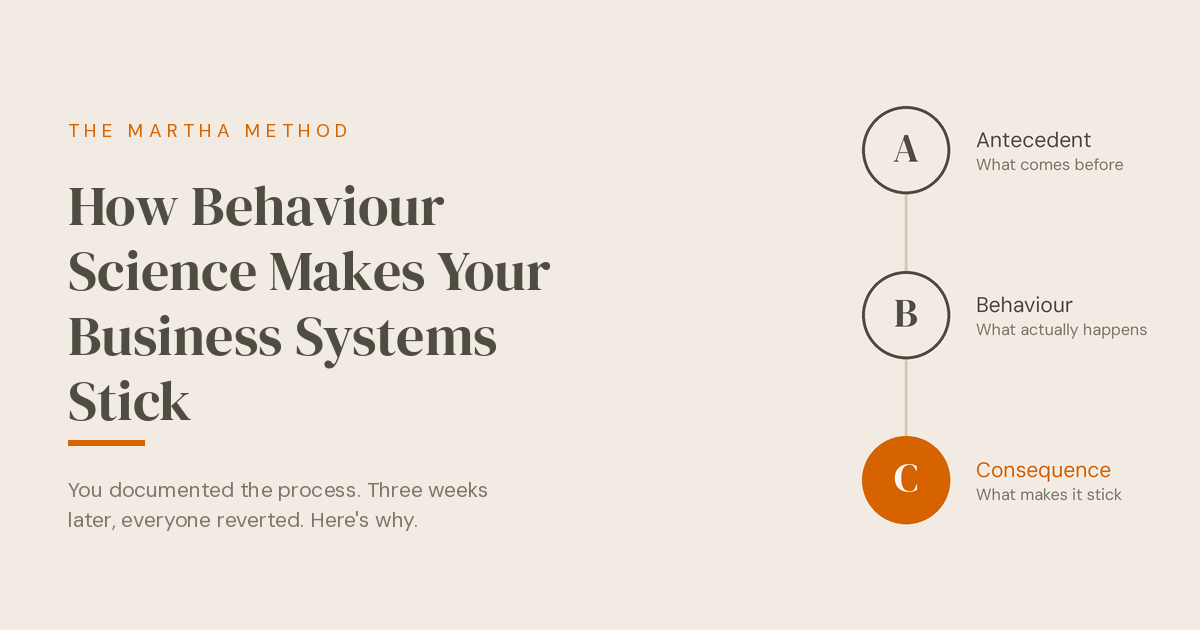
Here is a question I ask almost every new client: how many SOPs do you have that nobody follows? The answer is always more than zero. And the reason is almost never that the process was wrong or the people are bad. The reason is behaviour science, and specifically, the part of it that most operational frameworks completely ignore.
This is the final post in this series, and it is the one that ties everything else together. If you have read the other posts on this blog, you will have seen references throughout to ABC Analysis, to Performance Pinpointing, to consequence design and behavioural conditions. This post explains why that framework matters more than any specific tool, template, or piece of software you could implement in your business.
The pattern every business owner recognises
You identify a problem. Something is not working the way it should. You design a solution: a new process, a new tool, a clearer set of instructions. You roll it out. You brief the team. Everyone nods, agrees it makes sense, and commits to doing it.
Three weeks later, you notice things have quietly slipped back to how they were before. Not through rebellion or resistance. Just a slow, almost invisible drift back to the old pattern.
This experience is so common that most business owners assume it is simply how change works. That people are naturally resistant, that new habits are hard to build, that this is just the cost of running a team. None of that is quite right. What is actually happening is explainable, predictable, and preventable, once you understand the behaviour science underneath it.
Why traditional operational thinking gets this wrong
Most operational advice, and most operational consultants, focus almost entirely on one part of the behavioural equation: the antecedent. The thing that happens before the behaviour. The instruction, the process document, the tool, the training session.
This focus makes intuitive sense. If something is not happening the way you want, the obvious response is to explain it more clearly, document it more thoroughly, or provide a better tool to support it. And sometimes that is genuinely what is needed. Sometimes a process fails simply because it was never clearly explained.
But in the majority of cases I have seen across twelve years of operational work, the antecedent was never the actual problem. The process was reasonably well explained. The SOP was clear enough. The training was adequate. And the behaviour still did not stick.
This is where ABC Analysis becomes essential, because it forces you to look beyond the antecedent to the two elements that traditional operational thinking consistently ignores: the specific behaviour itself, and, most importantly, what happens after it.
The behaviour science principle that changes everything
Here is the core principle, stated plainly: behaviour is governed far more by its consequences than by what precedes it.
This is not opinion. It is one of the most well established findings in applied behaviour science, developed originally through decades of research into human and animal learning, and applied extensively in fields ranging from clinical psychology to organisational management to safety-critical industries like aviation and healthcare.
The principle is straightforward. A behaviour that produces a positive outcome for the person doing it becomes more likely to be repeated. A behaviour that produces no noticeable outcome, or a negative one, becomes less likely to be repeated, regardless of how well it was explained beforehand.
Apply this to your business. When a team member follows a new SOP correctly, what happens? In most businesses, the honest answer is nothing in particular. No acknowledgement. No visible benefit to them personally. The work simply gets done, and life continues. Meanwhile, when they revert to the old, faster, more familiar way of doing something, what happens? Also usually nothing. No correction. No consequence. The work still gets done, just via a different path, and nobody notices the difference in the moment.
Given a choice between a new behaviour that produces no noticeable consequence and an old, more comfortable behaviour that also produces no noticeable consequence, human behaviour reliably drifts toward the path of least resistance. This is not a character flaw. It is how behaviour works, for every person, in every organisation, without exception.
Why this explains the SOP problem specifically
Return to the question at the top of this post: how many SOPsdo you have that nobody follows?
Using the ABC framework, the diagnosis becomes clear. The antecedent, the SOP itself, exists and is reasonably well written. The behaviour, following the documented process, may happen for a period immediately after implementation, when the change is fresh and attention is high. But the consequence environment around that behaviour was never designed. Nothing reinforces following the SOP. Nothing corrects deviation from it. Over time, the behaviour drifts back to the pre-existing default, because the default requires less effort and produces an identical lack of consequence.
This is why simply rewriting an SOP that is not being followed rarely solves the underlying problem. The document was never the issue. The consequence environment around its use was.
What behaviour-based system design actually looks like
Understanding this principle changes how you approach operational work entirely. Instead of asking "how do I explain this process more clearly," the more useful question becomes "what happens when this behaviour occurs, and what happens when it does not."
In practice, this means building three things into every system you implement.
Visibility. You cannot reinforce a behaviour you cannot see. This means building reporting structures, tracking mechanisms, or review processes that make it possible to know whether the desired behaviour is actually happening, not assume that it is because the SOP exists.
Positive reinforcement for the desired behaviour. This does not need to be elaborate. Specific acknowledgement, visible recognition, or even simply someone noticing and commenting on correct execution is often enough to meaningfully shift the probability of a behaviour continuing. The key word is specific. Generic praise reinforces nothing because it is not connected clearly enough to the actual behaviour.
A response to the absence of the behaviour. Not punishment. A response. If a process is not being followed, that needs to be noticed and addressed, ideally quickly and constructively, focused on the behaviour rather than the person. Silence in the face of deviation is itself a powerful, if unintentional, signal that the deviation does not matter.
Every operational system I build, whether it is an onboarding process, a reporting rhythm, or a client delivery workflow, is designed with these three elements considered explicitly. Not as an afterthought, but as the foundation the system is built around.
Why this is different from most OBM or operations consulting work
I want to be direct about this, because it is the core of what makes my work distinct.
Most operational consulting, and most OBM services, focus on the antecedent layer almost exclusively. Better SOPs. Better tools. Better project management systems. This work has real value and I do plenty of it. But on its own, it consistently produces the pattern described at the start of this post: initial improvement followed by gradual reversion.
My background in Quality and Best Practice Training, working with applied behaviour science in corporate performance environments for over a decade, gave me the framework to see the part of the equation that gets missed.ABC Analysis and Performance Pinpointing are not abstract theory I apply for intellectual interest. They are the practical tools that explain why some operational changes stick permanently and others quietly dissolve within a month.
When I diagnose a problem in a client's business, I am not just looking at what process needs to be written or rewritten. I am analysing the full behavioural chain: what triggers the current behaviour, what the behaviour actually is, and critically, what is currently reinforcing or failing to reinforce it. The systems I build are designed around that full analysis, which is why they hold up over time rather than requiring the same fix to be reapplied every few months.
What this means for your business
If you recognise the pattern in this post, documenting something, implementing it, watching it fade, the fix is not to try harder at documentation. It is to look honestly at what happens after the behaviour you want, and after the behaviour you do not want, and to redesign that consequence environment deliberately.
This applies whether you are trying to fix a single broken process or trying to build the operational infrastructure for your entire business. The principle does not change with scale. What changes is the complexity of applying it consistently across every system, every team member, and every process simultaneously, which is difficult to do alone while also running the rest of your business.
That is the specific value an OBM trained in this methodology brings. Not just documentation. Not just better tools. A systematic application of behaviour science across every operational layer of your business, so that what gets built actually lasts.
Where to go from here
If this post has resonated and you want to understand more about how this methodology applies specifically to your business, the Ops Clarity Session is where that conversation happens. We will look at your specific operational challenges through this exact lens: not just what processes need fixing, but why the behaviours around them are not sticking, and what would need to change for that to be different.
And if you have made it through this entire series, from what an OBM does through to the behavioural science underneath why systems succeed or fail, you now understand more about operational design than most business owners ever will. That knowledge alone puts you in a stronger position to fix what is not working in your business, whether you do that work yourself or bring in support to do it with you.
Either way, a quick call with Martha is a good next step if you are still working out what your own situation calls for.